

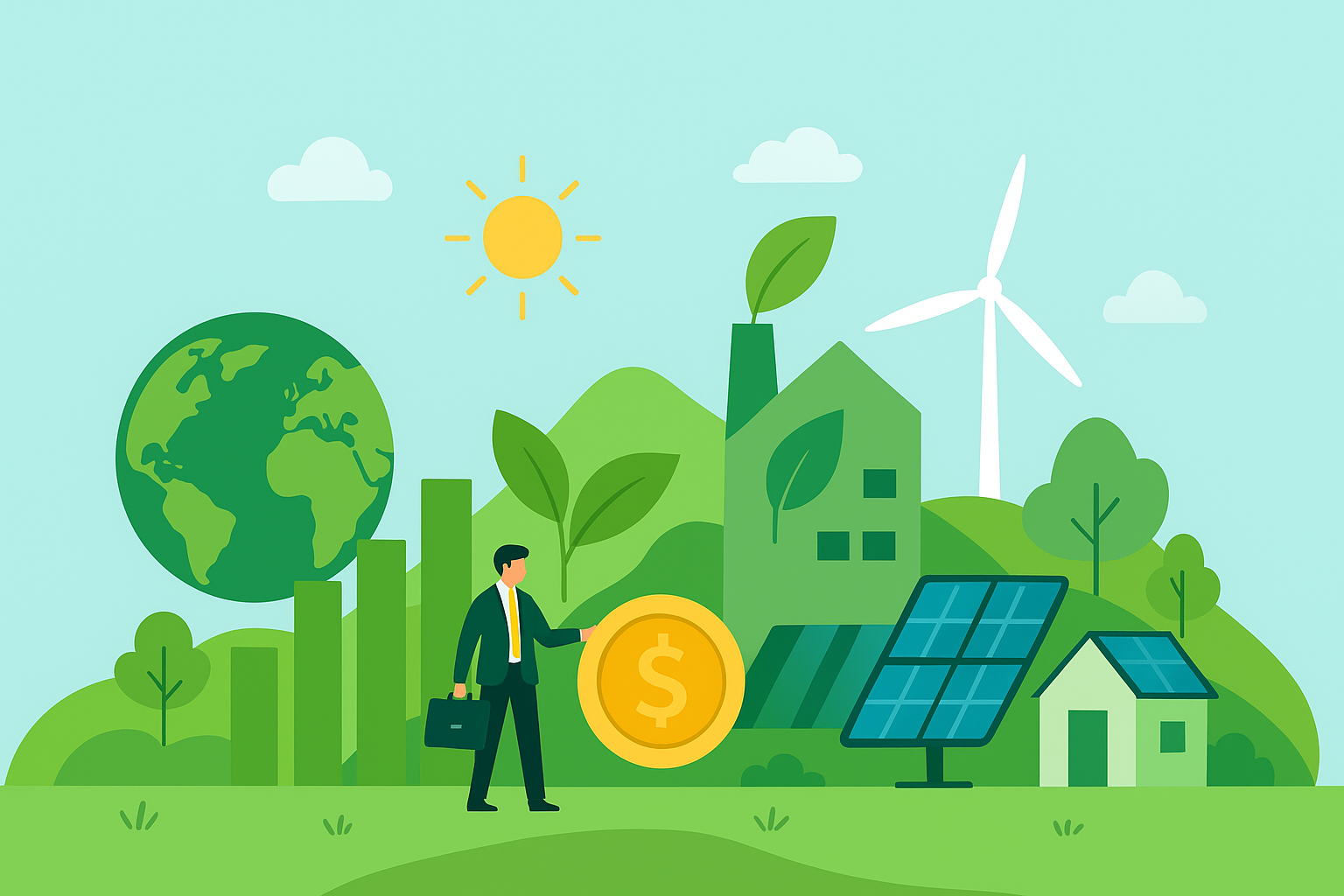
L’ÉCONOMIE VERTE À L’ÈRE DE LA COMMUNICATION INNOVANTE
Pour cité l’article :
BOUNIT, H., BOUNIT, A., & TAIBI, M. (2025). L’ÉCONOMIE VERTE À L’ÈRE DE LA COMMUNICATION INNOVANTE. REVUE DROIT ET SOCIETE, 6(17), 80‑95. https://doi.org/10.5281/zenodo.16921106
| BOUNIT Hammadi Enseignant chercheur Université ibn zohr Agadir, Maroc. |
| BOUNIT Ahmed Docteur en génie industrielle Université Cadi Ayyad, Marrakeche, Maroc |
| TAIBI Michaal Doctorant Université ibn zohr Agadir, Maroc |
RESUME
Face aux défis environnementaux croissants, la transition vers une économie verte s’impose comme une priorité stratégique pour les entreprises. Cet article explore le rôle fondamental d’une communication efficace dans l’accélération de cette transition. Il met en avant une approche de communication qui permet aux entreprises d’améliorer leur performance tout en renforçant leur responsabilité sociale et environnementale. À travers une étude de cas portant sur une entreprise marocaine du secteur agroalimentaire, cet article analyse comment l’intégration de pratiques écoresponsables, soutenue par une communication ciblée, a permis d’améliorer la compétitivité de l’entreprise sur le marché. Les résultats soulignent l’importance d’une approche intégrée où la communication devient un levier clé du développement durable, renforçant la confiance des parties prenantes et contribuant à la différenciation des entreprises engagées dans l’économie verte.
Mots-clés : économie verte, développement durable, responsabilité sociétale des entreprises (RSE), communication innovante.
THE GREEN ECONOMY IN THE ERA OF INNOVATIVE COMMUNICATION
ABSTRACT:
| BOUNIT Hammadi Research Lecturer Ibn Zohr University, Agadir, Morocco |
| BOUNIT Ahmed PhD in Industrial Engineering Cadi Ayyad University, Marrakesh, Morocco |
| TAIBI Michaal PhD Student Ibn Zohr University, Agadir, Morocco |
Faced with growing environmental challenges, the transition to a green economy has become a strategic priority for companies. This article explores the key role of effective communication in accelerating this transition. It highlights a communication approach that enables companies to improve their performance while strengthening their social and environmental responsibility. Through a case study of a Moroccan company in the agri-food sector, the article analyzes how the integration of eco-responsible practices, supported by targeted communication, has enhanced the company’s competitiveness in the market. The findings emphasize the importance of an integrated approach where communication becomes a key driver of sustainable development, fostering stakeholder trust and contributing to the differentiation of companies engaged in the green economy.
Keywords: green economy, sustainable development, corporate social responsibility (CSR), innovative communication, ecological transition
Bibliographie :
Ambec, S., & Lanoie, P. (2009). Performance environnementale et économique de l’entreprise. Économie et Prévision, (4), 71-94.
Attenborough, D. (2020). Une vie sur notre planète. Paris : Éditions Les Arènes.
Bihouix, P. (2014). L’âge des low tech : Vers une civilisation techniquement soutenable. Paris : Seuil.
Bounit, A., Irhirane, E., Bourquia, N., & Benmoussa, R. (2016). Design of a fuzzy model that integrates hygiene, safety, and environment systems for the assessment of the overall risk of machines. Proceedings of the Institution of Mechanical Engineers, Part O: Journal of Risk and Reliability, 230(4), 378-390.
Carroll, A. B. (1999). Corporate social responsibility: Evolution of a definitional construct. Business & Society, 38(3), 268-295.
Carroll, A. B., & Buchholtz, A. K. (2014). Business & society: Ethics, sustainability & stakeholder management. Boston, MA: Cengage Learning.
Castells, M. (2009). Communication et pouvoir. Paris : Armand Colin.
Cullet, P. (2015). Droit de l’environnement. Paris : Presses Universitaires de France.
Drucker, P. F. (2005). L’essentiel de Drucker : Les outils du leadership (trad. J.-P. Beaussier). Paris : Éditions d’Organisation.
Dupont, M. (2015). Stratégies de communication créative. Montréal : Presses de l’Université de Montréal.
Férone, G., et al. (2004). Ce que développement durable veut dire. Paris : Éditions d’Organisation.
Filloux, F., et al. (2019). Marketing digital : Stratégies & outils (5e éd.). Paris : Dunod.
Greffet, P., et al. (2012). Définir et quantifier l’économie verte. L’économie française, édition 2012. Récupéré de http://www.insee.fr/fr/ffc/docs_ffc/ref/ECOFRA12e_D3_eco_ver.pdf
Guilbert, C. (2017). Médias et environnement : Pour une écologie de l’information. Paris : CNRS Éditions.
International Organization for Standardization (ISO). (2004). ISO 14001: Système de management environnemental – exigences et lignes directrices pour son utilisation. Paris : ISO.
Larrue, C. (2010). La responsabilité sociale et environnementale des entreprises. Paris : La Découverte.
Lelièvre, M. (2019). Les stratégies de communication digitale. Paris : Dunod.
Meffre, L. (2008). Communication et entreprise : Enjeux et stratégies. Paris : Dunod.
Nafzaoui, M.-A., et al. (2020). Cadre juridique et institutionnel de la responsabilité sociétale des entreprises au Maroc. Revue Internationale des Sciences de Gestion.
Organisation de coopération et de développement économiques (OCDE). (2011). Vers une croissance verte. Récupéré de http://www.oecd.org/fr/croissanceverte/48537006.pdf
Organisation internationale du travail. (s.d.). Emplois verts : Pour un travail décent dans un monde durable. Récupéré de www.ilo.org
Peloille, B. (2011). La responsabilité sociale de l’entreprise. Paris : La Découverte.
Programme des Nations Unies pour l’environnement (PNUE). (2011). Vers une économie verte : Pour un développement durable et une éradication de la pauvreté. Synthèse à l’intention des décideurs. Nairobi : PNUE.
Programme des Nations Unies pour l’environnement (PNUE). (s.d.). Économie verte. Récupéré de www.unep.org/fr/decouvrir/l-economie-verte
The World Bank. (2012). Inclusive green growth: The pathway to sustainable development. Washington, DC: The World Bank.
Vivien, F.-D. (2013). 20-22 juin 2012 : Rio plus vain ? Développement durable et territoires, 4(3).
Zaccaï, E. (2002). Le développement durable : Dynamique et constitution d’un projet. Bruxelles : P.I.E.-Peter Lang.
Un commentaire
Comments are closed, but trackbacks and pingbacks are open.