

BOUACHRINE, F.-E. (2025). Conceptions du corps et pratiques de guérison : les rituels des Gnawa comme exemples. REVUE ECONOMIE ET SOCIETE, 4(2), 35‑54. https://doi.org/10.5281/zenodo.17116818
| Fatima-Ezzahra BOUACHRINE Professeur d’anthropologie Institut National des Sciences de l’Archéologie et du Patrimoine (INSAP- RABAT)Maroc |
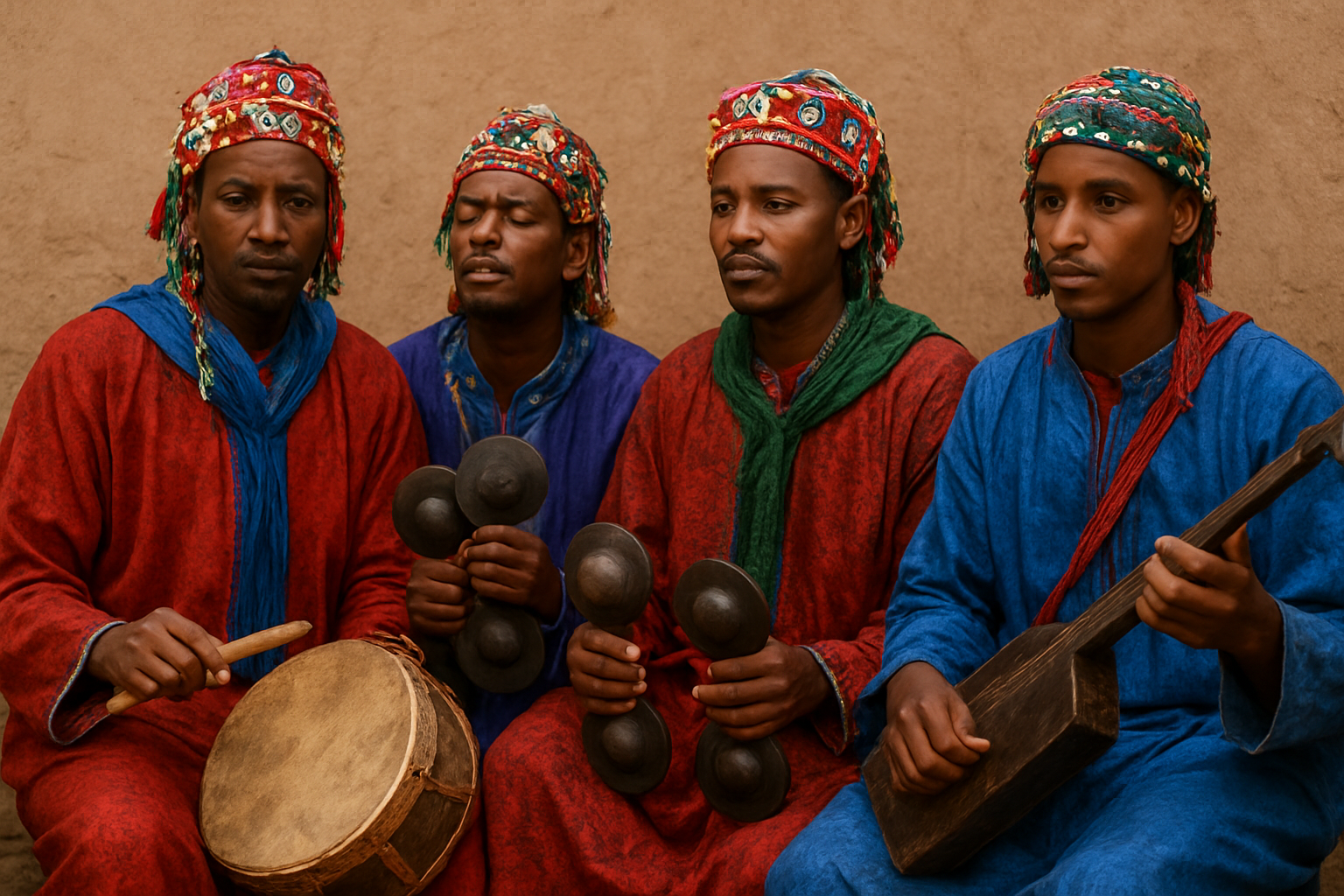
Cet article analyse différents aspects de la relation existant entre les notions de corps et les pratiques sociales (rituels et cérémonies traditionnelles) dans un cadre anthropologique, afin de démontrer comment la société marocaine conçoit les individus, leur expérience de vie, l’origine des corps, la mécanique des substances corporelles et leur signification. L’étude s’articule autour des dynamiques symboliques et culturelles qui façonnent ces pratiques, notamment la manière dont elles reflètent les rapports sociaux et les conceptions du corps en tant que médium entre le monde humain et spirituel. La relation entre ces notions culturelles et la manière dont les différences sociales et la résolution des afflictions sont instituées revêt une importance particulière dans le domaine de la transe de possession. En effet, la transe et d’autres états de conscience altérés, inscrits dans un cadre anthropologique de guérison, sont fortement associés aux pratiques des guérisseurs magico-religieux. Chez les Gnawa[1], les cérémonies de possession d’esprit génèrent des répertoires d’émotions dans l’édifice social, non seulement à travers des mots ou des images, mais aussi par le geste, le corps et ses sens, soulignant ainsi l’importance du corps dans les pratiques sociales et culturelles.
Mots-clés : Possession ; corps ; transe ; thérapie ; rituels ; anthropologie.
BODY CONCEPTIONS AND HEALING PRACTICES: THE RITUALS OF THE GNAWA AS EXAMPLES.
Abstract :
This article analyzes various aspects of the relationship between notions of the body and social practices (rituals and traditional ceremonies) within an anthropological framework, in order to demonstrate how Moroccan society conceives individuals, their life experiences, the origin of bodies, the mechanics of bodily substances, and their meanings. The study focuses on the symbolic and cultural dynamics that shape these practices, particularly how they reflect social relations and conceptions of the body as a medium between the human and spiritual realms. The relationship between these cultural notions and the way social differences and the resolution of afflictions are instituted is of particular importance in the context of possession trance. Indeed, trance and other altered states of consciousness, framed within an anthropological context of healing, are strongly associated with the practices of magico-religious healers. Among the Gnawa, spirit possession ceremonies generate repertoires of emotions within the social fabric, not only through words or images but also through gesture, the body, and the senses, thereby underscoring the importance of the body in social and cultural practices.
Keywords :Possession; body; trance; therapy; rituals; anthropology.
[1]Une confrérie religieuse populaire marocaine. Les Gnawa représentent, en effet, un patrimoine culturel venu d’Afrique Subsaharienne au cours du XVI e siècle. Ils possèdent un système qui leur est propre, de traditions spirituelles, reposant sur une énergie, un matériel et des informations qui forment une entité équilibrée.
Interviews :
Aḥmad. (2024, 2 Dimanche). Corps colonisés. (F. E. Bouachrine, Intervieweur)
Aicha. (2024, 3 Mercredi). Les stimuli rituels . (F. E. Bouachrine, Intervieweur)
Alaoui, A. (2024, 2 Mercredi). Initiation précoce. (F. E. Bouachrine, Intervieweur)
Alaoui, M. A. (2024, 2 Lundi). L’expérience corporelle . (F. E. Bouachrine, Intervieweur)
Aziz. (2024, 1 Mardi). Initiation précoce. (F. E. Bouachrine, Intervieweur)
Badiaa. (2024, 1 Jeudi). Intimité avec l’invisible. (F. E. Bouachrine, Intervieweur)
Fatima. (2024, 3 Mercredi). Corps colonisé . (F. E. Bouachrine, Intervieweur)
Fouzia. (2024, 3 Mercredi). Voyance et pouvoir occulte . (F. E. Bouachrine, Intervieweur)
Hassna. (2024, 2 Samedi). Fer qui libère . (F. E. Bouachrine, Intervieweur)
Kasri, H. (2024, 2 Vendredi ). Initiation précoce. (F. E. Bouachrine, Intervieweur)
Malika. (2024, 3 Dimanche). Initiation précoce. (F. E. Bouachrine, Intervieweur)
Meriem. (2024, 3 Vendredi ). Les stimuli rituels . (F. E. Bouachrine, Intervieweur)
Miloud. (2024, 2 Lundi ). Intimité avec l’invisible. (F. E. Bouachrine, Intervieweur)
Mokhtar. (2024, 3 Lundi). L’expérience corporelle. (F. E. Bouachrine, Intervieweur)
Mourad. (2024, 2 Lundi). Initiation précoce. (F. E. Bouachrine, Intervieweur)
Nadia. (2024, 2 Dimanche). Voyance et pouvoir occulte . (F. E. Bouachrine, Intervieweur)
Rachida. (2024, 2 Vendredi). Corps colonisé . (F. E. Bouachrine, Intervieweur)
Raḥma. (2024, 2 Mardi). Corps colonisé . (F. E. Bouachrine, Intervieweur)
Saadia. (2024, 2 Lundi). Fer qui libère . (F. E. Bouachrine, Intervieweur)
Touria. (2024, 3 Dimanche ). Les stimuli rituels . (F. E. Bouachrine, Intervieweur)
Zitoun, A.-M. (2022, 1 Mardi). L’expérience corporelle . (F. E. Bouachrine, Intervieweur)
Bibliographie:
BELANGER, M. A. (2007). The Psychic Energy Codex: Awakening Your Subtle Senses. San Francisco: Weiser Books .
BOSSINGER, W. H. (1993). Musique et états de conscience extraordinaires. Revue de musicothérapie ; vol. 14, n° 3 , p. 239-254.
BOURDIEU, P. (1972). Esquisse d’une théorie de la pratique, précédée de trois études d’ethnologie kabyle. Éditions Droz.
BOURGUIGNON, E. (1976). Possession. Chandler & Sharp Series in Cross-cultural Themes. San Francisco: Chandler & Sharp Publishers, 78 p.
BOURGUIGNON, E. ( 1979). Psychological Anthropology: An introduction to Human Nature and cultural differences. New York: Holt, Rinchart, and Winston.
BOURGUIGNON, E. (1973). Religion, Altered States of Consciousness, and social change. Columbus: Ohio state university press, 389 p.
CHIJIOKE NJOKU, R. (2006). Culture and Customs of Morocco. London: Greenwood Publishing Group.
CONNERTON, P. (1989). How Societies Remember. Cambridge et New York: Cambridge University Press.
DIOURI, A. T. (2011). Medical Pluralism in Morocco: The Cultural, Religious, Historical and Political-Economic Determinants of Health and Choice. SIT Morocco: Multiculturalism and Human Rights , https:// digitalcollections. sit. edu/ cgi/ viewcontent. cgi?referer=https:// www.google.com/ &httpsredir=1 &article=2005 &context= isp_collection .
DOUGLAS, M. (1966). Purity and Danger: An Analysis of Concepts of Pollution and Taboo. Routledge.
El HAMEL, C. (2013). Black Morocco: A History of Slavery, Race, and Islam. Cambridge et New York: Cambridge University Press.
EMBER, M. E. (2003). Encyclopedia of Sex and Gender: Men and Women in the World’s Cultures Topics and Cultures A-K – Volume 1; Cultures L-Z. New York: Springer.
FIRTH, R. (2013). We the Tikopia: A sociological study of kinship in primitive Polynesia. New York: Routledge.
HESS, P. R. Trance. Changer la conscience de veille. Dans H.H.DECKER-VOIGT, P. KNILL et E. WEYMANN (éd.). Musicothérapie lexique. Göttingen : Hogrefe.
HURSKAINEN, A. (2004). Invasion of spirits: Epidemiological spirit possession, among the Maasai of Tanzania. Nordic Journal of African Studies 14, Special Issue, Disponible sur: http:// www. njas. helsinki. fi/ pdf-files/ vol13Special/ pepo. pdf .
KAPCHAN, D. (2007). Traveling Spirit Masters: Moroccan Gnawa Trance and Music in the Global Market place. Middletown: Wesleyan University Press.
KEENER, C. S. (2010). The Spirit in the Gospels and Acts: Divine Purity and Power. Michigan: Ada.
KNUTSSON, K. E. (1975). Possession and extra-institutional behaviour: an essay in anthropological micro-analysis, ; vol. 40. 244-72.
LEVI-STRAUSS, C. ( 1955). L’étude structurale du mythe. Journal of American Folklore : 68 (270) , 428-444.
LITTLEWOOD, R. (2004; vol. 3, n ° 8,). Possession states. Psychiatrie , p. 8-10. Disponible sur:https://doi.org/10.1383/psyt.3.8.8.43392.
MAUSS, M. (1934.). « Les techniques du corps ». Paris :Journal de PUF, 1950, Psychologie XXXII (3-4): 271-293. , [Repris dans Sociologie et anthropologie, pp. 363-386].
PANDOLFO, S. (1997). Impasse of the Angels: Scenes from a Moroccan Space of Memory. Chicago et London: University of Chicago Press.
PLANCKE, C. ( 2011). The spirit’s wish : Possession trance and female power among the Punu of Congo-Brazzaville. Journal of Religion in Africa; vol. 41, n ° 4 , 366-95.
ROEHLKEPARTAIN, E. C. (2006). The Handbook of Spiritual Development in Childhood and Adolescence. London et New York: SAGE.
ROUGET, G. (1985). Music and Trance: A Theory of the Relations Between Music and Possession. Chicago et London: University of Chicago Press.
SPIRO, M. E. (1996 (Première publication 1967)). Burmese Supernaturalism. New Brunswick et London: Transaction Publishers.
WESTERMARCK, E. (2014). Ritual and Belief in Morocco: Vol. I . New York: Routledge.
YOUNG, K. ( 1997). Presence in the Flesh: The Body in Medicine. London et Cambridge: Harvard University Press.
YOUNG, K. (2002, pp. 45-46.). Embodied Memory: Affect and Gesture in Family Dynamics: Routledge.
Comments are closed, but trackbacks and pingbacks are open.