


| Ibtissam GHAICH Doctorante en droit public, Université Mohammed V de Rabat, Maroc |
RESUME
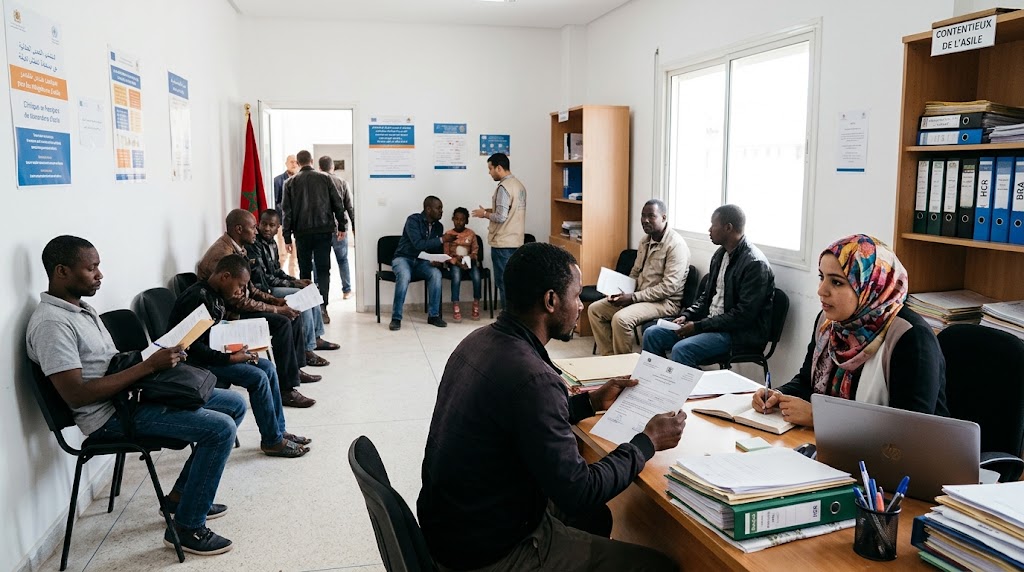
Le préambule de la Constitution marocaine du 29 juillet 2011 accorde aux conventions internationales dûment ratifiées et publiées la primauté sur le droit interne. L’article examine l’usage que les juridictions font de ce fondement lorsqu’elles statuent sur la situation des réfugiés et des demandeurs d’asile, dans un pays qui n’a pas encore adopté de loi sur l’asile. Il repose sur un corpus de treize décisions et actes rendus entre 2013 et 2025 par des juridictions administratives, répressives et du statut personnel, de même que par un parquet, que complètent les décisions du Comité contre la torture relatives à des procédures d’extradition. Sur des bases conventionnelles, les juges du fond ont construit des solutions protectrices convergentes, avec des mesures d’éloignement écartées, la relaxe de personnes poursuivies pour séjour irrégulier et l’inscription à l’état civil d’enfants nés de parents demandeurs d’asile. Cette mobilisation varie selon la nature de l’opération que le texte interne demande au juge. Là où une disposition nationale attache une conséquence à une qualité que le juge constate sur pièces, la protection suit. Là où le texte suppose l’appréciation du mobile réel d’un État requérant, le juge de l’extradition s’en tient à la régularité de la demande.
Mots-clés : Maroc ; asile ; réfugiés ; primauté conventionnelle ; office du juge ; non-refoulement.
THE PRIMACY OF INTERNATIONAL CONVENTIONS PUT TO THE TEST OF ASYLUM LITIGATION IN MOROCCO
ABSTRACT
| Ibtissam GHAICH PhD Candidate in Public Law Mohammed V University of Rabat, Morocco |
The preamble of the Moroccan Constitution of 29 July 2011 grants duly ratified and published international conventions primacy over domestic law. This article examines how Moroccan courts use that foundation when ruling on the situation of refugees and asylum seekers, in a country that has yet to adopt an asylum law. It draws on a corpus of thirteen decisions and acts issued between 2013 and 2025 by administrative, criminal and personal status courts and by a public prosecutor’s office, supplemented by the decisions of the Committee against Torture on extradition proceedings. Lower courts have built convergent protective solutions on treaty grounds, removal measures set aside, acquittal of persons prosecuted for irregular stay, and civil registration of children born to asylum-seeking parents. This engagement varies with the kind of operation that the domestic provision requires of the court. Where a national provision attaches a consequence to a status that the court establishes from documents, protection follows. Where the provision presupposes an assessment of the real motive of a requesting State, the extradition court confines itself to the formal regularity of the request.
Keywords: Morocco; asylum; refugees; primacy of international treaties; judicial function; non-refoulement.
Armstrong-Stassen, M., & Ursel, N. D. (2009). Perceived organizational support, career satisfaction, and the retention of older workers. Journal of Occupational and Organizational Psychology, 82(1), 201–220. https://doi.org/10.1348/096317908X288838
Bacharach, S. B., Bamberger, P., & Conley, S. (1991). Work–home conflict among nurses and engineers: Mediating the impact of role stress on burnout and satisfaction at work. Journal of Organizational Behavior, 12(1), 39–53. https://doi.org/10.1002/job.4030120104
Blau, P. M. (1964). Exchange and power in social life. Wiley.
Christensen, T., Lægreid, P., & Rykkja, L. H. (2016). Organizing for crisis management: Building governance capacity and legitimacy. Public Administration Review, 76(6), 887–897. https://doi.org/10.1111/puar.12558
Cohen, J. (1988). Statistical power analysis for the behavioral sciences (2nd ed.). Lawrence Erlbaum Associates.
Colquitt, J. A., LePine, J. A., & Wesson, M. J. (2015). Organizational behavior: Improving performance and commitment in the workplace (4th ed.). McGraw-Hill Education.
Cropanzano, R., & Mitchell, M. S. (2005). Social exchange theory: An interdisciplinary review. Journal of Management, 31(6), 874–900. https://doi.org/10.1177/0149206305279602
Daniels, K., Watson, D., & Gedikli, C. (2017). Well-being and the social environment of work: A systematic review of intervention studies. International Journal of Environmental Research and Public Health, 14(8), 918. https://doi.org/10.3390/ijerph14080918
Eisenberger, R., & Stinglhamber, F. (2011). Perceived organizational support: Fostering enthusiastic and productive employees. American Psychological Association. https://doi.org/10.1037/12318-000
Eisenberger, R., Huntington, R., Hutchison, S., & Sowa, D. (1986). Perceived organizational support. Journal of Applied Psychology, 71(3), 500–507. https://doi.org/10.1037/0021-9010.71.3.500
Giauque, D., Ritz, A., Varone, F., Anderfuhren-Biget, S., & Waldner, C. (2011). Putting public service motivation into context: A balance between universalism and particularism. International Review of Administrative Sciences, 77(2), 227–253. https://doi.org/10.1177/0020852311399232
Gouldner, A. W. (1960). The norm of reciprocity: A preliminary statement. American Sociological Review, 25(2), 161–178.
Hair, J. F., Jr., Hult, G. T. M., Ringle, C. M., & Sarstedt, M. (2022). A primer on partial least squares structural equation modeling (PLS-SEM) (3rd ed.). SAGE.
Henseler, J., Ringle, C. M., & Sarstedt, M. (2015). A new criterion for assessing discriminant validity in variance-based structural equation modeling. Journal of the Academy of Marketing Science, 43, 115–135. https://doi.org/10.1007/s11747-014-0403-8
Kingdom of Morocco. (2023a). Dahir No. 1-22-77 of 9 December 2022 promulgating Framework Law No. 06-22 relating to the national health system. Bulletin Officiel du Royaume du Maroc, No. 7178, 16 March 2023.
Kingdom of Morocco. (2023b). Dahir No. 1-23-50 of 28 June 2023 promulgating Law No. 08-22 relating to the creation of Territorial Health Groups. Bulletin Officiel du Royaume du Maroc, No. 7213, 17 July 2023.
Kingdom of Morocco. (2023c). Dahir No. 1-23-51 of 28 June 2023 promulgating Law No. 09-22 relating to the health-service employment framework. Bulletin Officiel du Royaume du Maroc, No. 7213, 17 July 2023.
Kock, N. (2015). Common method bias in PLS-SEM: A full collinearity assessment approach. International Journal of e-Collaboration, 11(4), 1–10.
Kurtessis, J. N., Eisenberger, R., Ford, M. T., Buffardi, L. C., Stewart, K. A., & Adis, C. S. (2017). Perceived organizational support: A meta-analytic evaluation of organizational support theory. Journal of Management, 43(6), 1854–1884. https://doi.org/10.1177/0149206315575554
Labrague, L. J., & De los Santos, J. A. A. (2020). COVID-19 anxiety among front-line nurses: Predictive role of organizational support, personal resilience and social support. Journal of Nursing Management, 28(7), 1653–1661. https://doi.org/10.1111/jonm.13121
Meyer, J. P., & Allen, N. J. (1997). Commitment in the workplace: Theory, research, and application. SAGE.
Ministry of Health, Morocco. (2016, April 6). Lancement officiel des œuvres sociales. Ministry of Health.
OECD. (2023). Health at a glance 2023: OECD indicators. OECD Publishing. https://doi.org/10.1787/ae3016b9-en
Paarlberg, L. E., & Perry, J. L. (2007). Values management: Aligning employee values and organization goals. The American Review of Public Administration, 37(4), 387–408. https://doi.org/10.1177/0275074006297238
Podsakoff, P. M., MacKenzie, S. B., Lee, J.-Y., & Podsakoff, N. P. (2003). Common method biases in behavioral research: A critical review of the literature and recommended remedies. Journal of Applied Psychology, 88(5), 879–903. https://doi.org/10.1037/0021-9010.88.5.879
Rhoades, L., & Eisenberger, R. (2002). Perceived organizational support: A review of the literature. Journal of Applied Psychology, 87(4), 698–714. https://doi.org/10.1037/0021-9010.87.4.698
Ringle, C. M., Wende, S., & Becker, J.-M. (2024). SmartPLS 4. SmartPLS. https://www.smartpls.com
Schaufeli, W. B., & Taris, T. W. (2014). A critical review of the Job Demands–Resources model: Implications for improving work and health. In G. F. Bauer & O. Hämmig (Eds.), Bridging occupational, organizational and public health: A transdisciplinary approach (pp. 43–68). Springer. https://doi.org/10.1007/978-94-007-5640-3_4
Shmueli, G., Sarstedt, M., Hair, J. F., Cheah, J.-H., Ting, H., Vaithilingam, S., & Ringle, C. M. (2019). Predictive model assessment in PLS-SEM: Guidelines for using PLSpredict. European Journal of Marketing, 53(11), 2322–2347. https://doi.org/10.1108/EJM-02-2019-0189
Shore, L. M., & Shore, T. H. (1995). Perceived organizational support and organizational justice. In R. S. Cropanzano & K. M. Kacmar (Eds.), Organizational politics, justice, and support: Managing the social climate of the workplace (pp. 149–164). Quorum Books.
Vroom, V. H. (1964). Work and motivation. Wiley.
World Health Organization. (2016). Global strategy on human resources for health: Workforce 2030. World Health Organization.
World Health Organization. (2020). State of the world’s nursing 2020: Investing in education, jobs and leadership. World Health Organization.
Wright, B. E., & Pandey, S. K. (2010). Public organizations and mission valence: When does mission matter? Journal of Public Administration Research and Theory, 20(1), 75–98. https://doi.org/10.1093/jopart/mup006
Comments are closed, but trackbacks and pingbacks are open.